Product Description
Sorry, this item is no longer available for sale. If you initiate a reproduction request, we need a min order of 10-20 units/item.


Sorry, this item is no longer available for sale. If you initiate a reproduction request, we need a min order of 10-20 units/item.
| Dimensions | 80L x 20W x 78H (cm) |
|---|

Construction of the vessel began in 1795 at Hartt Shipyard in Boston following the design of Joshua Humphrey from Philadelphia. The CONSTITUTION was launched in October 1797 and was completed in 1798. She was armed with 44 cannons, including 30 long-barrelled 24-pounders.
In the war between England and France (1812-1814) the CONSTITUTION led a successful engagement against the frigates GUERRIERE (with 38 cannons) and JAVA. Her last wartime voyage was in February 1815.

The San Felipe Launched in 1690, was one of the most beautiful Spanish ships of its era. She was led the Spanish Armada. San Felipe's role in the war against the British and French was to help protect Spanish settlements and harbors but also to transport gold from the new world. The San Felipe was armed with 96 cannons enough firepower to match the best ships the French and British navies had to offer. In 1705, the San Felipe fought a heroic battle against 35 British ships but was captured by an English ship and badly damaged and ended up at the bottom of the ocean with several tons of gold.

Esmeralda is a steel-hulled four-masted barquentine tall ship of the Chilean Navy and currently the second tallest and longest sailing ship in the world.
The ship is the sixth to carry the name Esmeralda. The first was the frigate Esmeralda captured from the Spanish at Callao, Peru, by Admiral Lord Thomas Alexander Cochrane of the Chilean Navy, in a bold incursion on the night of 5 November 1820. The second was the corvette Esmeralda of the Chilean Navy which, set against superior forces, fought until sunk with colors flying on 21 May 1879 at the Battle of Iquique. These events mark important milestones for the Chilean Navy and the ship's name is said to evoke its values of courage and sacrifice.
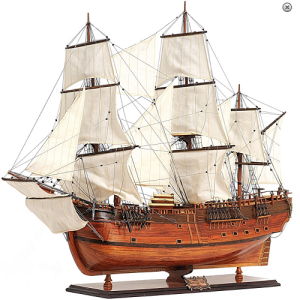
HMS Endeavour, also known as HM Bark Endeavour, was a British Royal Navy research vessel commanded by Lieutenant James Cook on his first voyage of discovery, to Australia and New Zealand from 1769 to 1771.
Launched in 1764 as the collier Earl of Pembroke, she was purchased by the Navy in 1768 for a scientific mission to the Pacific Ocean, and to explore the seas for the surmised Terra Australis Incognita or “unknown southern land”. Renamed and commissioned as His Majesty's Bark the Endeavour, she departed Plymouth in August 1768, rounded Cape Horn, and reached Tahiti in time to observe the 1769 transit of Venus across the Sun. She then set sail into the largely uncharted ocean to the south, stopping at the Pacific islands of Huahine, Borabora, and Raiatea to allow Cook to claim them for Great Britain. In September 1769, she anchored off New Zealand, the first European vessel to reach the islands since Abel Tasman's Heemskerck 127 years earlier. In April 1770, Endeavour became the first seagoing vessel to reach the east coast of Australia, when Cook went ashore at what is now known as Botany Bay.

Reviews
There are no reviews yet.