Product Description
Sorry, this item is no longer available for sale. If you initiate a reproduction request, we need a min order of 10-20 units/item.


Sorry, this item is no longer available for sale. If you initiate a reproduction request, we need a min order of 10-20 units/item.
| Dimensions | 80L x 20W x 78H (cm) |
|---|

Esmeralda is a steel-hulled four-masted barquentine tall ship of the Chilean Navy and currently the second tallest and longest sailing ship in the world.
The ship is the sixth to carry the name Esmeralda. The first was the frigate Esmeralda captured from the Spanish at Callao, Peru, by Admiral Lord Thomas Alexander Cochrane of the Chilean Navy, in a bold incursion on the night of 5 November 1820. The second was the corvette Esmeralda of the Chilean Navy which, set against superior forces, fought until sunk with colors flying on 21 May 1879 at the Battle of Iquique. These events mark important milestones for the Chilean Navy and the ship's name is said to evoke its values of courage and sacrifice.

The first large three-decker, the Royal Louis was completed in Toulon in 1668, and was registered at 200 tons. The Royal Louis was a 3-deck vessel with 120 guns. Her captain was a Squadron Admiral. She was one of the most powerful firsrank vessels belonging to the French Royal Navy at that time. Our ship model represents the Royal Louis according to the plans of 1779, when she was Admiral-Ship of the Blue and White Squadron, being part of the American Squadron, also called Eark d’Estaing’s.
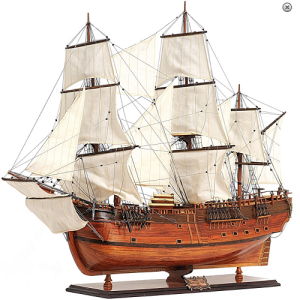
HMS Endeavour, also known as HM Bark Endeavour, was a British Royal Navy research vessel commanded by Lieutenant James Cook on his first voyage of discovery, to Australia and New Zealand from 1769 to 1771.
Launched in 1764 as the collier Earl of Pembroke, she was purchased by the Navy in 1768 for a scientific mission to the Pacific Ocean, and to explore the seas for the surmised Terra Australis Incognita or “unknown southern land”. Renamed and commissioned as His Majesty's Bark the Endeavour, she departed Plymouth in August 1768, rounded Cape Horn, and reached Tahiti in time to observe the 1769 transit of Venus across the Sun. She then set sail into the largely uncharted ocean to the south, stopping at the Pacific islands of Huahine, Borabora, and Raiatea to allow Cook to claim them for Great Britain. In September 1769, she anchored off New Zealand, the first European vessel to reach the islands since Abel Tasman's Heemskerck 127 years earlier. In April 1770, Endeavour became the first seagoing vessel to reach the east coast of Australia, when Cook went ashore at what is now known as Botany Bay.

Viking ships were marine vessels of particular designs used and built by the Vikings during the Viking Age. The boat-types were quite varied, depending on what the ship was intended for, but they were generally characterized as being slender and flexible boats, with symmetrical ends with true keel. They were clinker built, which is the overlapping of planks riveted together. Some might have had a dragon's head or other circular object protruding from the bow and stern, for design, although this is only inferred from historical sources.

Reviews
There are no reviews yet.