Product Description
Sorry, this item is no longer available for sale. If you initiate a reproduction request, we need a min order of 10-20 units/item.


The Santa María was built in Pontevedra, Galicia, in Spain's north-west region. The Santa María was probably a medium-sized nau (carrack), about 58 ft (17.7 m) long on deck, and according to Juan Escalante de Mendoza in 1575, the Santa Maria was “very little larger than 100 toneladas” (about 100 tons, or tuns) burthen, or burden, and was used as the flagship for the expedition. The Santa María had a single deck and three masts.
The other ships of the Columbus expedition were the biggercaravel-type ships Santa Clara, remembered as La Niña (“The Girl”), and La Pinta (“The Painted”). All these ships were second-hand (if not third- or more) and were not intended for exploration. The Niña, Pinta, and the Santa María were modest-sized merchant vessels comparable in size to a modern cruising yacht. The exact measurements of length and width of the three ships have not survived, but good estimates of their burden capacity can be judged from contemporary anecdotes written down by one or more of Columbus' crew members, and contemporary Spanish and Portuguese shipwrecks from the late 15th and early 16th centuries which are comparable in size to that of the Santa Maria. These include the ballast piles and keel lengths of the Molasses Reef Wreck and Highborn Cay Wreck in the Bahamas. Both were caravel vessels 19 m (62 ft) in length overall, 12.6 m (41 ft) keel length and 5 to 5.7 m (16 to 19 ft) in width, and rated between 100 and 150 tons burden. The Santa María, being Columbus' largest ship, was only about this size, and the Niña and Pinta were smaller, at only 50 to 75 tons burden and perhaps 15 to 18 meters (50 to 60 feet) on deck (updated dimensional estimates are discussed below in the section entitled Replicas).
Sorry, this item is no longer available for sale. If you initiate a reproduction request, we need a min order of 10-20 units/item.
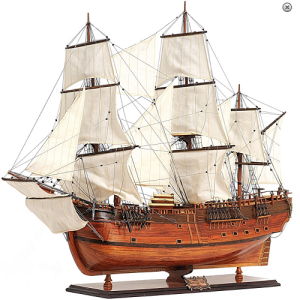
HMS Endeavour, also known as HM Bark Endeavour, was a British Royal Navy research vessel commanded by Lieutenant James Cook on his first voyage of discovery, to Australia and New Zealand from 1769 to 1771.
Launched in 1764 as the collier Earl of Pembroke, she was purchased by the Navy in 1768 for a scientific mission to the Pacific Ocean, and to explore the seas for the surmised Terra Australis Incognita or “unknown southern land”. Renamed and commissioned as His Majesty's Bark the Endeavour, she departed Plymouth in August 1768, rounded Cape Horn, and reached Tahiti in time to observe the 1769 transit of Venus across the Sun. She then set sail into the largely uncharted ocean to the south, stopping at the Pacific islands of Huahine, Borabora, and Raiatea to allow Cook to claim them for Great Britain. In September 1769, she anchored off New Zealand, the first European vessel to reach the islands since Abel Tasman's Heemskerck 127 years earlier. In April 1770, Endeavour became the first seagoing vessel to reach the east coast of Australia, when Cook went ashore at what is now known as Botany Bay.

The San Felipe Launched in 1690, was one of the most beautiful Spanish ships of its era. She was led the Spanish Armada. San Felipe's role in the war against the British and French was to help protect Spanish settlements and harbors but also to transport gold from the new world. The San Felipe was armed with 96 cannons enough firepower to match the best ships the French and British navies had to offer. In 1705, the San Felipe fought a heroic battle against 35 British ships but was captured by an English ship and badly damaged and ended up at the bottom of the ocean with several tons of gold.

The Protecteur as a 64 gunship as a matter of fact never existed!
It seems that the Paris (France) 'Musée de la Marine' 64 gunship model had been wrongfully named by the admiral Pâris, keeper of the museum at the end of the 19th Century. He thus christened this model with the help of a commentary written on a time register, but whithout checking the name's truthfulness, especially regarding the ship's armament.

'Juan Sebastián de Elcano is a training ship of the Spanish Navy. It is a four-masted topsail, steel-hulled barquentine (schooner barque). At 113 meters (371 ft) long, it is the third-largest tall ship in the world and is the sailing vessel that has sailed the furthest, covering more than 2,000,000 nautical miles (3,700,000 km; 2,300,000 mi) in its lifetime.
It is named after Spanish explorer Juan Sebastián Elcano, captain of Ferdinand Magellan's last exploratory fleet and the man who completed the first circumnavigation of the world. The ship carries the Elcano coat of arms, which was granted to the family by Emperor Charles I following Elcano's return in 1522 from Magellan's global expedition. The coat of arms is a globe with the motto “Primus Circumdedisti Me” (meaning: “First to circumnavigate me”).'

Reviews
There are no reviews yet.